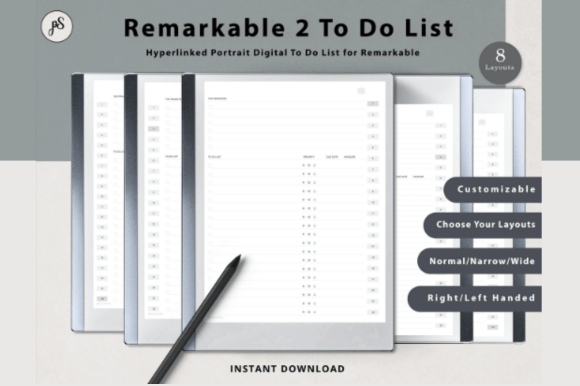
Stop Losing Action Items with This Remarkable 2 Strategy
We have all been there: you leave a meeting feeling energized, but three days later, you can’t remember what you actually promised to deliver. The chaos of scribbled notes, crossed-out lines, and mixed-up thoughts often leads to missed deadlines and miscommunication. For professionals ranging from freelance designers to corporate marketers, the meeting is only productive if the action items are captured and executed. This is where a structured digital workflow changes everything. Using the Remarkable 2 Templates to Do List bundle transforms your tablet from a simple digital notebook into a powerhouse of productivity and organization.
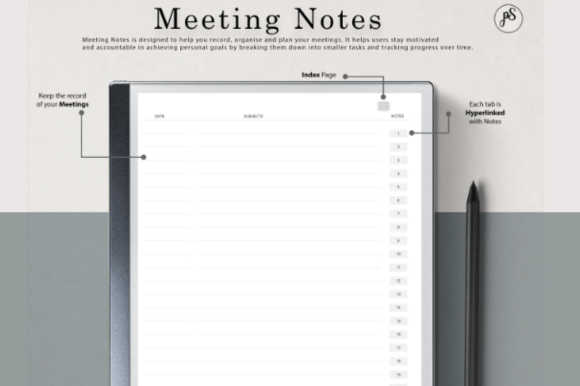
The Anatomy of an Effective Meeting Note
A good to-do list notebook should be a useful tool that helps keep everyone on the same page and ensures that actions are taken and decisions are implemented. However, a blank page often invites chaos. The Remarkable 2 Templates to Do List approach solves this by providing pre-structured layouts. Unlike standard lined paper, these templates feature distinct zones for different types of information. You will typically find a header section for the date, time, and attendees, followed by a large area for general notes. Crucially, the best templates include dedicated columns or checkboxes specifically for "Decisions Made" and "Action Items."
This structure mirrors how we think about visual hierarchy in design. Just as a display font grabs attention on a poster, the bold headers in these templates draw your eye to the most critical data points. The layout prevents the "wall of text" effect, ensuring that when you review your notes later, the follow-up tasks aren't buried in paragraphs of brainstorming. It is a practical application of modern typography principles applied to personal productivity.
Visual Style and Personality
When you look at the Remarkable 2 Templates to Do List bundle, you aren't just seeing grids; you are seeing a design system. The personality of these templates is clean, professional, and utilitarian. They strip away unnecessary ornamentation to focus on function, much like a high-quality sans serif font used in web design. The visual characteristics rely on light greys, crisp lines, and ample whitespace. This isn't just for aesthetics; whitespace is essential for legibility on an e-ink screen.
The style appeals to the modern creative professional who values minimalism. Whether you are a brand strategist mapping out a campaign or a small business owner tracking inventory, the aesthetic feels neutral enough to fit any brand identity without clashing. It avoids the rigid, corporate feel of a 1990s spreadsheet, instead offering a fluid, modern look that encourages creativity while maintaining order. The templates act as a design asset, giving your notes a polished, professional appearance every time you write.
Strategic Applications for Professionals
The versatility of the Remarkable 2 Templates to Do List extends far beyond simple minute-taking. For entrepreneurs and content creators, these templates serve as a bridge between ideation and execution.
- Client Work and Freelancing: If you are a designer, use the meeting notes template to record client feedback in real-time. By structuring the feedback into "Keep," "Change," and "New Request" sections, you create a clear paper trail that protects you from scope creep.
- Project Management: The planner templates included in the bundle allow you to take those immediate action items from a meeting and drop them directly into your weekly schedule. This ensures that decisions don't just sit in a notebook; they get assigned a deadline.
- Brand Consistency: For marketers managing multiple campaigns, consistency is key. Using a standardized template ensures that every meeting, whether with the social media team or the copywriters, is documented in the exact same way. This creates a searchable, logical archive of your brand’s history.
Improving Readability and Focus
One of the most underrated aspects of using the Remarkable 2 Templates to Do List is how it influences your cognitive load. When you don't have to think about where to write or how to organize your thoughts, your brain can focus entirely on the content of the meeting. This is the physical equivalent of choosing a legible serif font for a long-form article—it removes friction.
The templates guide your pen. They prompt you to summarize decisions rather than just transcribing words. This shift from passive listening to active summarization is a skill that top executives and publishers rely on. Furthermore, the structure helps with readability after the fact. Scanning a page for a specific action item is infinitely faster when you know exactly where the checkbox section is located. It turns your tablet into a reliable editorial design tool where information is curated, not just collected.
Practical Guidance for Implementation
Adopting the Remarkable 2 Templates to Do List system requires a slight mindset shift. First, evaluate the specific needs of your role. If you are in packaging design, you might need templates that allow for quick sketching alongside text notes. If you are a blogger, you might prefer a layout that highlights content ideas and publishing dates.
Start by testing the default templates included in the bundle. Pay attention to the sizing. On the Remarkable 2, you can zoom in, but it is often better to write at the native scale to maintain the visual structure intended by the template designer. Treat these templates like a premium font—they are a tool that enhances your output quality. If you find the standard list too restrictive, look for variations that include a "brain dump" section for mind mapping.
Finally, integrate this into your daily workflow immediately. Do not wait for a "big meeting" to start. Use the Remarkable 2 Templates to Do List for your daily stand-up, your grocery list, or your brainstorming sessions. The more you use the structure, the more natural it becomes. You will find that your ability to capture decisions and execute tasks improves simply because your tools are no longer fighting against you, but working with you to build a more organized professional life.